On this page
Hong Kong has two different kinds of safety training obligation, and mixing them up is how employers end up either over-confident or over-spending. One is a specific duty: for certain high-risk work, the worker must personally hold a certificate from a government-recognised course. The other is a general duty: every employer must give staff the information, instruction, training and supervision their work needs.
Requirements checked on 26 October 2026 against the Labour Department pages listed at the end. Safety law changes and course recognition lists are updated without notice, so confirm the current position with the Labour Department before relying on any date here.
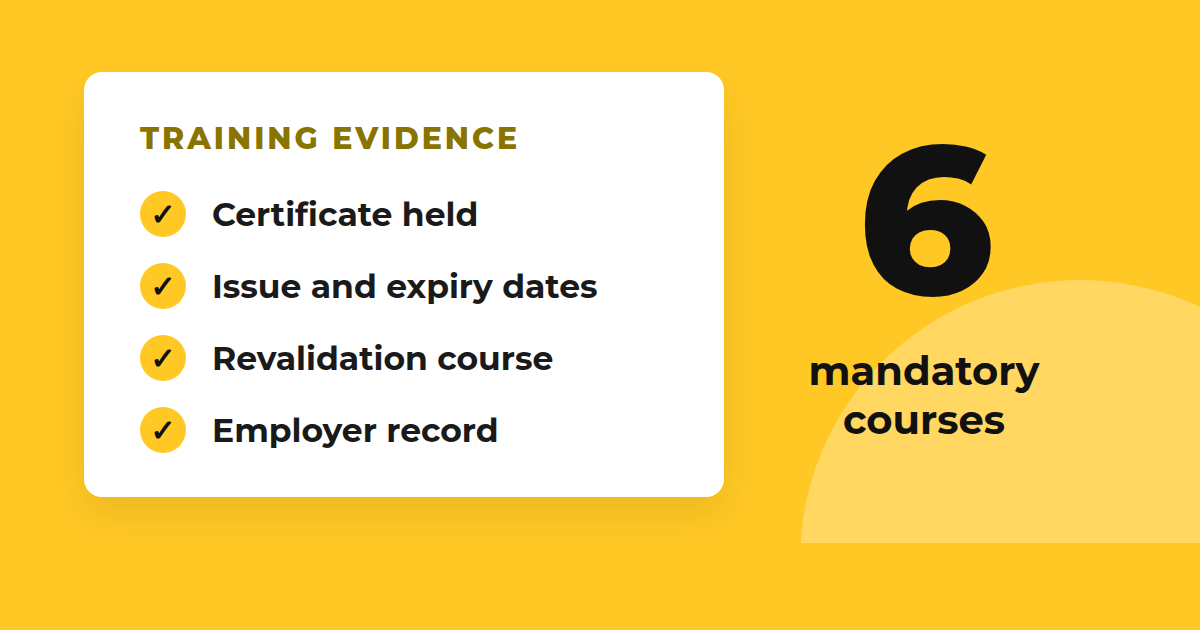
The six mandatory safety training courses
The Labour Department states that workers engaged in specified high-risk industries, activities or machinery operations must hold the relevant certificate from these recognised courses:
| Course | Who it applies to |
|---|---|
| Mandatory Basic Safety Training (Green Card / 平安卡) | Persons employed to carry out construction work or container-handling operations in an industrial undertaking |
| Confined Spaces Safety Training | Workers required to enter or work in confined spaces |
| Training Courses for Operators of Crane | Crane operators |
| Training Courses for Operators of Loadshifting Machine | Operators of loadshifting machinery |
| Training Courses for Persons Working on Suspended Working Platforms | Persons working on suspended working platforms (e.g. gondolas) |
| Gas Welding Safety Training | Workers performing gas welding |
The certificate is issued by a training course provider recognised by the Commissioner for Labour. Anyone enrolling may choose among the recognised providers — there is no single official school — which is exactly why the certificate itself, and who issued it, matters as evidence.
The Green Card: who needs it, and when it lapses
All persons employed to carry out construction work or container-handling operations in an industrial undertaking must have received mandatory basic safety training. The requirement has applied since 1 May 2001: since that date, only a person who has completed the training and holds a valid certificate may be employed for that work.
The certificate is popularly called the Green Card, or 平安卡. On validity, the Labour Department’s FAQ is specific:
the validity period is one to three years, and will be marked on the card. If the validity period is not marked on the card, the card will be valid within three years from the date of issue — section 6BA(6) of the Factories and Industrial Undertakings Ordinance (Cap. 59).
Renewal is not automatic. A holder must complete a revalidation course run by a recognised provider before the existing card expires; the renewed card is issued by that provider. A lapsed card is not a paperwork slip — under the requirement above, the person should not be carrying out that work.
Two practical consequences follow. First, a one-year card and a three-year card in the same team expire on different cycles, so “we checked at induction” is not a control. Second, because revalidation is a course with limited capacity, leaving renewal to the expiry month is how a worker gets pulled off a job for a fortnight.
The general duty that reaches every workplace
Separate from the six certificates, the Occupational Safety and Health Ordinance (Cap. 509) imposes general duties. Its coverage is deliberately broad: it applies to almost all workplaces where employees work — factories and construction sites, but also offices, laboratories, shopping malls and educational institutions. A handful of places are excluded, including aircraft or vessels in public places, the driver’s position of a land transport vehicle in a public place, domestic premises where the only employees are domestic servants, and places where only self-employed people work.
Among the employer’s duties, the Ordinance requires the employer to:
- provide and maintain plant and work systems that do not endanger safety or health;
- make arrangements for the safe use, handling, storage and transport of plant and substances;
- provide all necessary information, instruction, training and supervision to ensure the safety and health of employees at work;
- provide and maintain safe access to and egress from the workplace; and
- provide and maintain a safe and healthy working environment.
That third duty is the one training teams own. It is written in general terms, so “necessary” depends on the actual work — which is why a risk assessment, rather than a course catalogue, should drive what gets taught. It also means an office employer is not exempt from training duties simply because no one operates a crane.
On enforcement, the Commissioner for Labour may issue an improvement notice or a suspension notice where workplace activity poses an imminent risk. Failure to comply with these notices is an offence carrying fines of HK$400,000 and HK$1,000,000 respectively, and imprisonment of up to 12 months.
What to record, and why expiry is the hard part
A defensible safety training record answers five questions without a phone call:
- Who completed it — the individual, not the team or the contractor company.
- Which course — the exact course name, since “safety training” covers very different things.
- Who issued it — the recognised provider, because recognition is what makes the certificate valid.
- When it was issued and when it expires — both dates, not just the issue date.
- Whether revalidation has been booked — the open item, not just the completed one.
Most organisations hold items 1 to 4 at the point of induction and lose item 5. The failure mode is predictable: a worker is certified in year one, changes role in year two, and nobody re-checks because no one is notified. The record exists; it is simply never looked at again.
This is also where the two kinds of obligation need separating in the record. A mandatory certificate has an external expiry date set by law. Site-specific or role-specific training given under the general duty has no statutory expiry, but it does need a review date set by the employer based on the risk. Mixing the two in one undifferentiated list is why renewal gets missed.
Where company safety training fits
Employers can use a site induction to teach their own reporting procedures, emergency arrangements and safe work instructions. A refresher can ask employees to practise what to do when a hazard is spotted or a procedure changes. The Labour Department’s recognised courses and valid certificates still apply where the work requires them.
For a digital induction, give the course designer a real task, the company’s current procedure and an example of the decision an employee needs to make. Explore bespoke courseware for employer-led training or check the Labour Department’s list of recognised Green Card courses.
Common mistakes
- Treating the Green Card as the whole obligation. A construction worker may hold a valid Green Card and still need confined space or crane certification for a specific task.
- Accepting a certificate without checking the issuer. Validity depends on the course being recognised by the Commissioner for Labour. The Labour Department has warned about fraudsters offering guaranteed certificates; using false documents is a serious criminal offence and such a certificate is invalid.
- Assuming an office has no duties. Cap. 509 covers offices and requires instruction, training and supervision appropriate to the work.
- Recording completion but not expiry. A record with an issue date and no expiry date cannot answer the only question that matters at an audit: is it still valid?
- Expecting an internal course to substitute for a mandatory one. In-house induction is valuable and expected under the general duty; it does not replace a statutory certificate.
Where a system helps
None of the above is difficult to understand. It is difficult to keep true across hundreds of workers, six course types, several contractors and expiry dates that fall on different days. A learning management system earns its place here by doing three unglamorous things: holding the certificate evidence against each person, calculating the expiry date from the issue date rather than trusting someone to remember it, and surfacing the renewals due in the next quarter while there is still time to book a course.
For the training that is not a statutory certificate — site inductions, safe work procedures, role-specific risk training — the same system carries the review cycle the employer set. If you are weighing how those internal courses should be built, off-the-shelf versus custom e-learning sets out the trade-off; how to choose an LMS covers what to ask a vendor about records and reporting specifically.
Sources
- Labour Department: Mandatory Safety Training Courses
- Labour Department FAQ: safety training courses and Green Card renewal
- Labour Department: Occupational Safety and Health Ordinance (Cap. 509)
Cyberwisdom Asia Ltd. is a Hong Kong provider of learning management systems, CPD compliance software and bespoke courseware, serving 800+ enterprise clients since 1999.
About Cyberwisdom