On this page
A card that lasts five years, and a certificate that may not
Consider a hypothetical that recurs every time a residential or commercial guarding contract is re-tendered. A contract for an estate changes hands. The incoming company takes over the site and, in practice, most of the officers. One of them has more than a decade in the industry, a permit with years still to run, and a course certificate issued more than five years ago.
The permit answers the question the officer cares about: he may do security work. The certificate answers a different question, the one his new employer’s own licensing depends on: whether he can be put on a post on day one without sitting the basic course again. The five years have already run out on the certificate. A decade of experience does not restore it, because the notice says the training requirement applies “regardless of previous working experience” and only steps aside when a valid certificate is produced.
That is the shape of the problem. It is not that anyone is careless. It is that the two documents live in different places, expire on different dates, and are usually reconciled by an operations manager in the week a contract starts, when there is no time to reconcile anything.
What each period is actually measuring
Three periods govern a guard’s paperwork, and only one of them is printed on the card he carries.
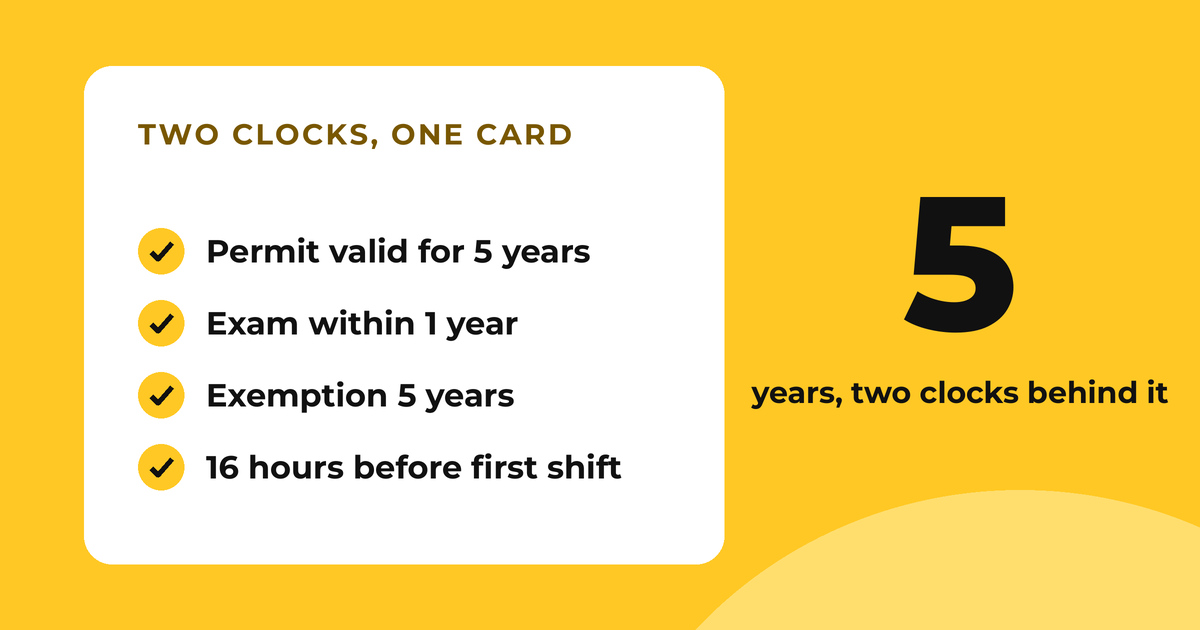
The permit is the simple one. A permit is valid for five years, or such shorter period as the Commissioner of Police may specify, and renewal is applied for not earlier than six months and not later than three months before it expires. That is a fixed property of the card: it has one expiry date and one renewal window, and both are about the person.
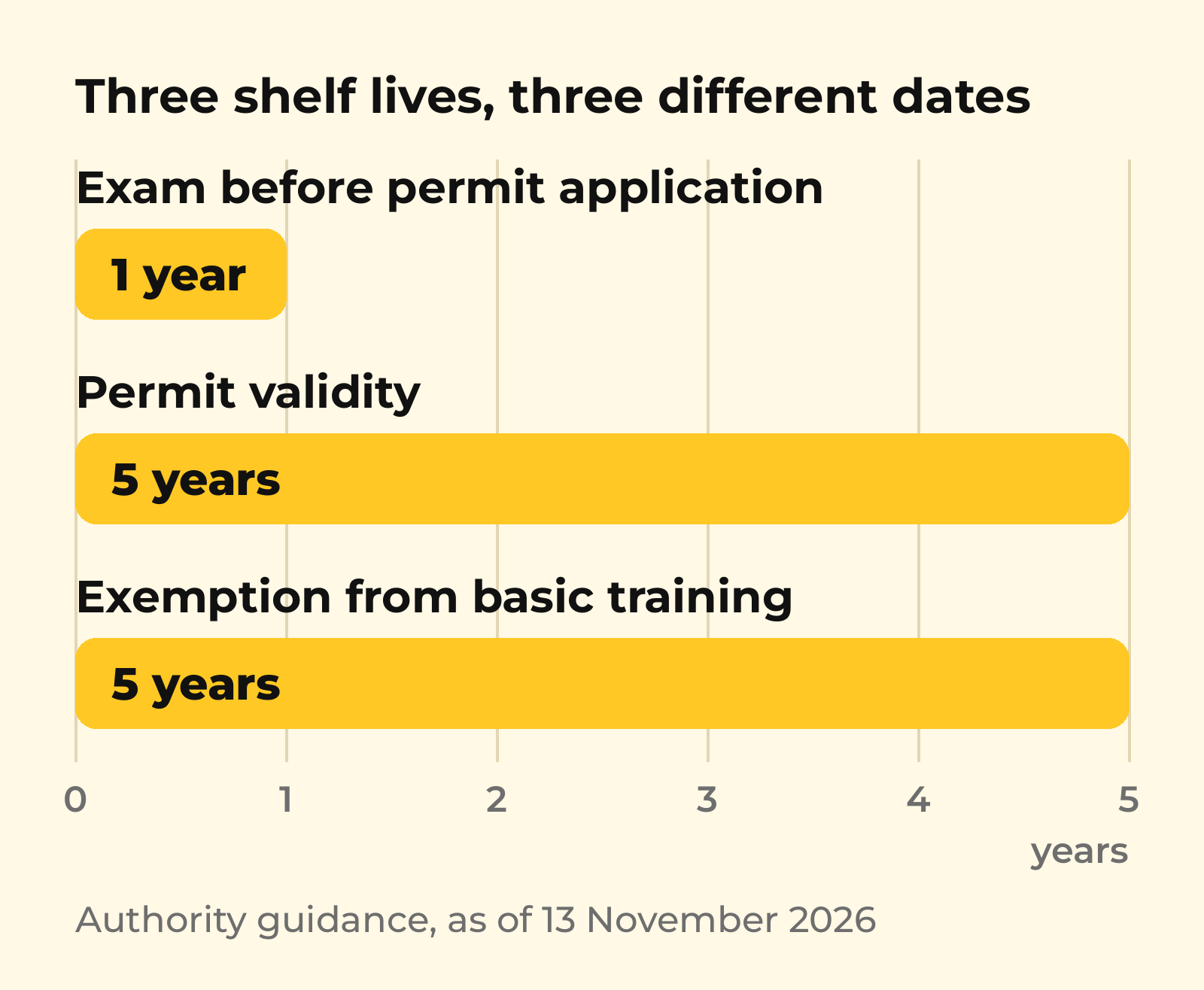
The certificate is the complicated one, because the same document is measured twice. For a new permit application, the Authority states that an applicant for a Category A, B and/or C permit who “has sat and passed a course-end examination, within 1 year before submitting his/her application, of a security training course that has met the requirements of a scheme for quality assurance that has been endorsed by the Authority” is deemed to have met the criterion of proficiency in security work. One year, counted backwards from the date of application.
For the employer, the Authority states that a person who has successfully completed a valid recognised course, passed its examination and can produce a valid certificate can be exempted from the basic training on being employed by a security company, and that the exemption is valid for five years from the date of successful completion of the course. Five years, counted forwards from the day the course ended.
So the same certificate has two ages, and they are not the same age. A certificate older than a year but younger than five is too stale to support a new permit application, and still good enough to exempt its holder from a new employer’s basic training. A certificate younger than a year does both. A certificate older than five years does neither, and its holder is then in the same position as a new entrant, whatever his file says about experience.
That asymmetry is the part people miss. The certificate that gets a person into the industry is not the certificate that keeps him deployable, and the second one expires quietly, five years after a date that appears nowhere on his permit.
What the Authority looks at on the employer’s side
The training requirements are not in the licence document. They are in the notice the Authority publishes under section 6(1)(b)(iii) of the Ordinance, which sets out the matters the Authority has regard to when determining an application for a security company licence. That distinction is worth holding on to: a manager who opens his company’s licence looking for the training clause will not find it there, and may conclude there is nothing to comply with.
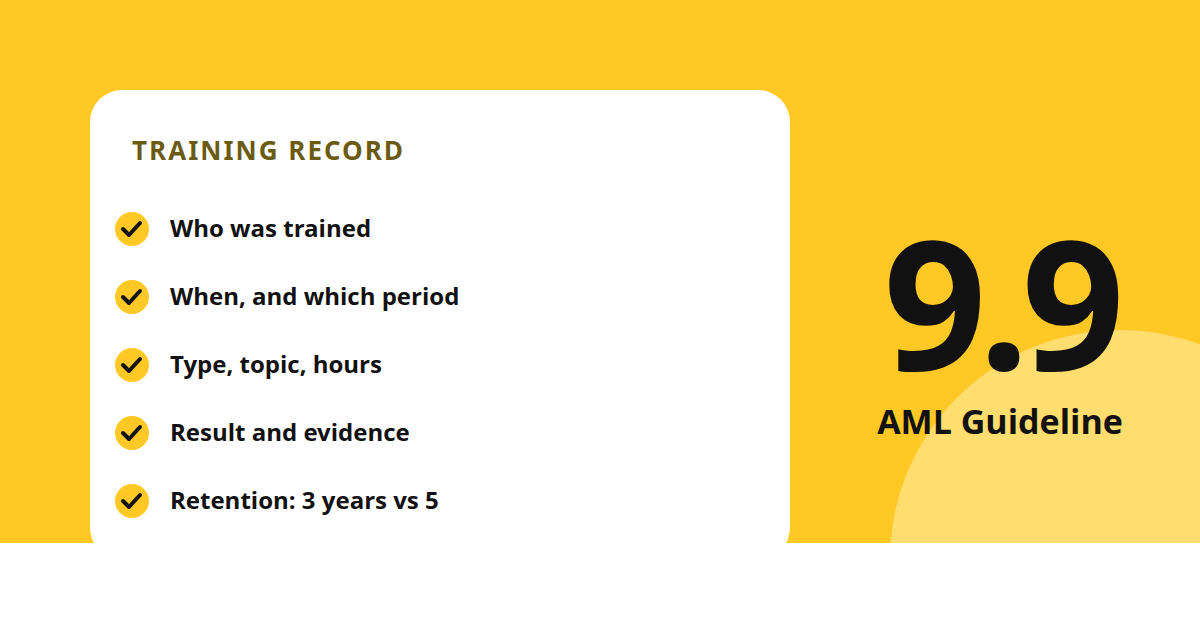
The notice asks for three things that matter here. The company must have a nominated training officer responsible for the training of all operational staff. Every employee, before performing operational duties, must undergo and pass an initial basic training course of not less than 16 hours, unless he produces a valid certificate issued in respect of a course accepted by the Authority within five years. And the results of these courses must be recorded in the employee personnel files.
That last sentence is the one worth reading twice. The notice does not name a learning system, a spreadsheet or a training register. It names the employee personnel file. Whatever else a company keeps, the file is the object the notice describes, and a learning record that never reaches the file is, in the literal terms of the requirement, an incomplete answer.
The syllabus is fixed enough to matter for course design. The same notice lists what the 16 hours have to cover: the guard’s role and general duties, conduct and behaviour, uniform and equipment, legal responsibilities and relevant legislation, fire prevention and procedures, handling of emergencies, reporting and recording, access control and patrolling, health and safety, and courtesy and customer relations. A short induction video does not cover that list, and the notice does not offer a shorter route for experienced staff.
Four traces that never sit in one place
Ask a training administrator to prove that a particular guard was trained, and the answer usually lives in four places at once.
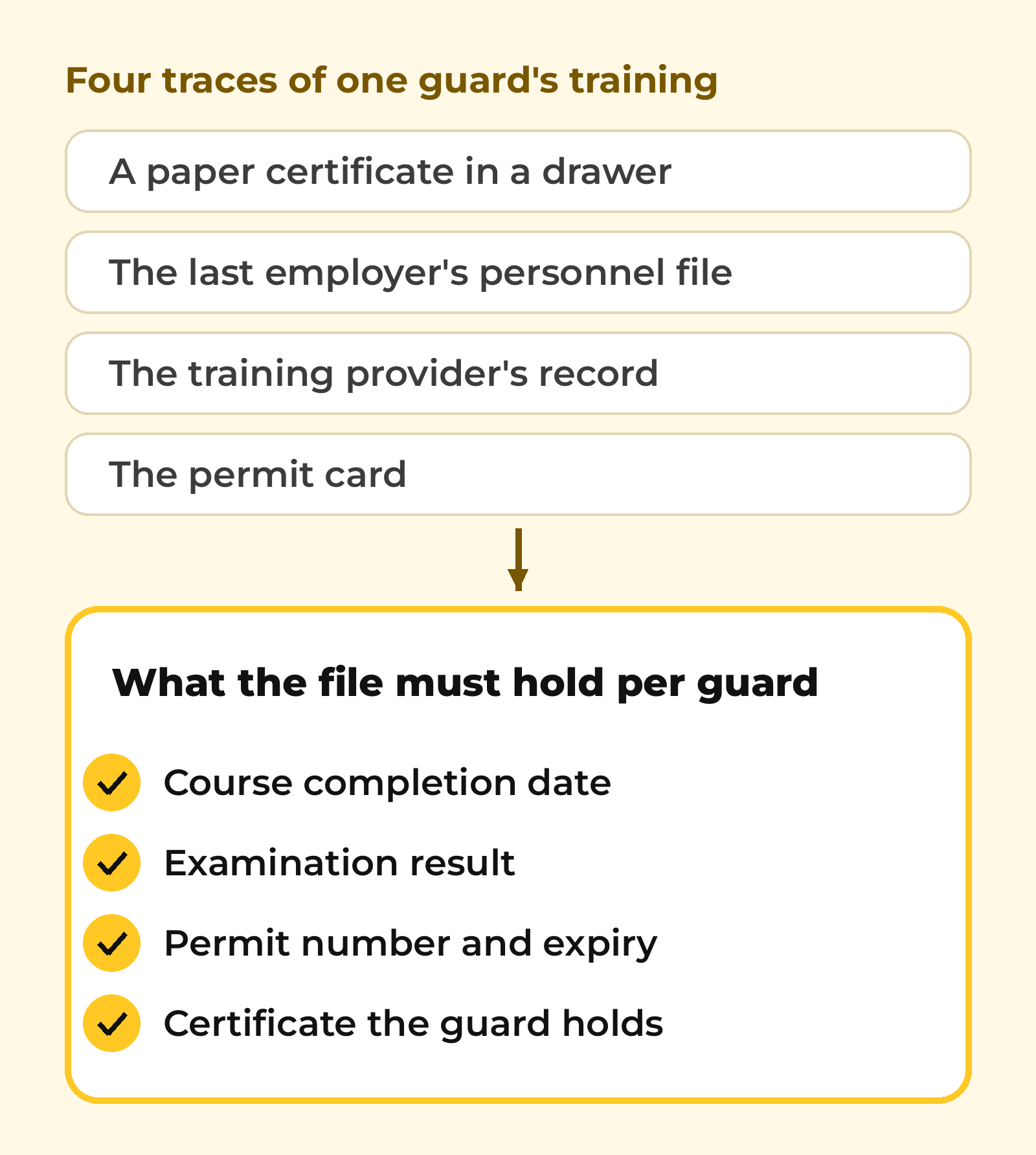
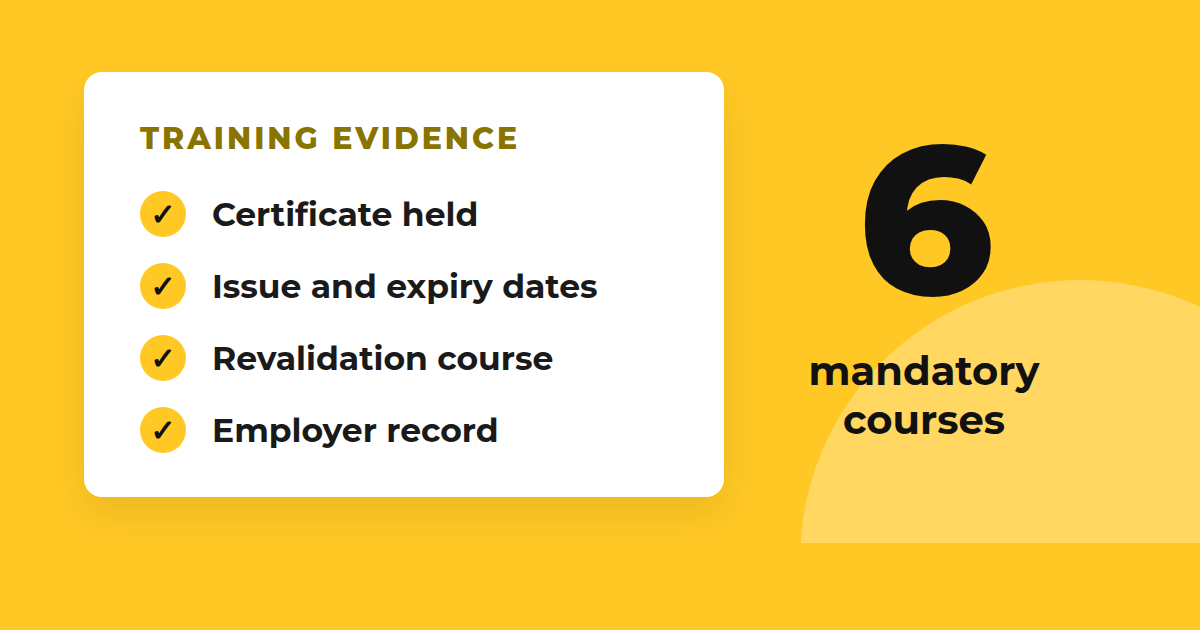
The guard’s own certificate carries the completion date. The previous employer’s file carries the result, if anyone can obtain it. The training provider keeps its own record of who sat the course. The permit card carries the permit number and its expiry, and nothing about training at all. Each trace is partial, and none of them is wrong; they simply do not meet unless someone puts them next to the same name.
That is a record-keeping job before it is a software job, and it is worth being precise about where a platform helps and where it does not. UpLearn checks completion against criteria set for each course, automatically, after each learning activity and each grading (capability R-01), so a course that ends in an examination produces a completion status rather than a certificate in an envelope. Certificates can be linked to a course or an examination, carry an expiry date, and trigger reminders to learners, managers or administrators before they lapse (capability R-10), which covers the part of this that runs on a calendar rather than on a form. And learners can download their own certificates and review their own learning record (capability LM-02), which matters in a trade where the person, not the company, is the one who has to produce proof when he moves.
What the platform cannot do is decide whether a certificate is acceptable to the Authority, or fill a personnel file that nobody opens. Those remain management acts, on a date, by a named person.
The week a contract changes hands
A takeover is where scattered dates become a scheduling problem rather than a filing problem. The incoming company inherits people whose certificates are of unknown age, and it has to decide, for each of them, whether the five-year exception applies before the first shift.

The notice anticipates this. A security company that takes over another company’s business as well as its staff may apply in writing to the Police, with valid reasons, for a grace period in providing initial basic training to its guards before performing operational duties. The wording matters: the application is in writing, it needs reasons, and it is discretionary. It is not an automatic extension, and it is not something an operations manager can grant himself on the morning the contract starts.
Two things are usually discovered late in that week. The first is that the personnel file stays with the employer, and a company that has lost a contract has no obvious reason to hand over its records to the winner, even where it is willing to. The second is that the certificate does travel, because it was issued to the person, but only if the person still has it. Certificates kept in a drawer at a site that has just changed hands are, for practical purposes, gone.
The Monday after the award
The training administrator arrives with a start date and a staff list. Before anything else, she marks three dates against each name: when the recognised course was completed, when the examination was passed, and when the permit expires. Most of the list will be fine, and the exercise takes an afternoon because the dates are already in the certificate copies and the permit register.
The names that are not fine split into two groups, and the split is the whole decision. Anyone whose course completion falls inside five years can be posted while their file is tidied up. Anyone outside it needs the 16-hour course before the first shift, or needs the company to put in the written grace period application early enough for the Police to answer before the contract starts. Neither is a decision to leave to the first morning on site.
Then the quiet part. The result of each course goes into the personnel file, not only into whatever system holds the training record, and each guard leaves with a copy of his certificate in his own hands. Six months later, when he is standing at a different site for a different employer and someone asks what he has done, that copy is the only part of this record that is still within reach.
Two limits are worth stating. This article summarises the Authority’s published wording as of 13 November 2026 and is not legal advice; what the Police Licensing Office asks for at renewal, beyond the application window, is outside it, as is any additional requirement a particular client site writes into its own contract. Where the two differ, the site’s contract is a commercial obligation on top of the Authority’s licensing requirements, not a substitute for them.
Sources
- Security and Guarding Services Industry Authority: How to apply for a Security Personnel Permit under the Security and Guarding Services Ordinance, Cap. 460
- SGSIA: Quality Assurance System for Recognition Scheme of Security Training Courses, how the scheme operates, April 2021
- SGSIA: Matters to which the Authority shall have regard when determining an application for a security company licence, notice under section 6(1)(b)(iii), Government Gazette 24 February 2012
Cyberwisdom Asia Ltd. is a Hong Kong provider of learning management systems, CPD compliance software and bespoke courseware, serving 800+ enterprise clients since 1999.
About Cyberwisdom