On this page
- Key takeaways
- The duty to appoint, and what it quietly depends on
- What the four-year clock actually asks for
- Which hours count, and which count less than you would think
- The person who runs your training is the person whose clock is running
- What an employer can hold without owning someone else’s duty
- The version of this that fails
- Sources
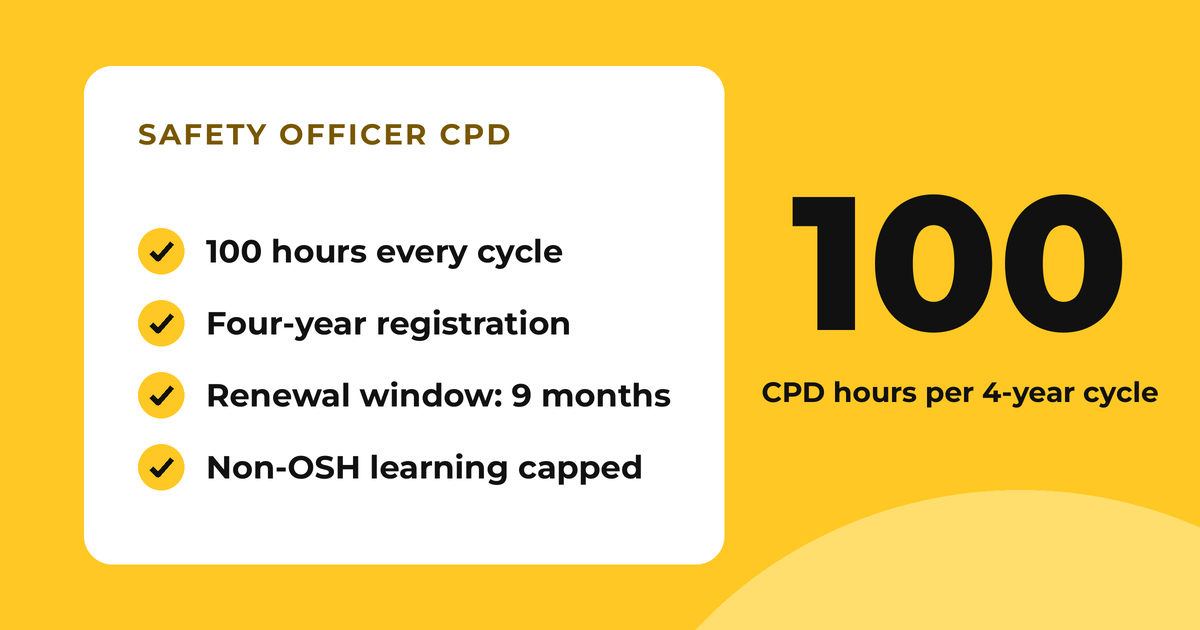
If a registered safety officer appears on your organisation chart in Hong Kong, somebody on your payroll is holding something the company does not own. The Factories and Industrial Undertakings (Safety Officers and Safety Supervisors) Regulations cover construction sites, shipyards and container handling workplaces, and the Labour Department states the headcount for one of them: proprietors of container handling workplaces who employ 100 or more persons are required to employ a registered safety officer. What usually surprises employers is what the appointment then rests on. The registration belongs to the individual, it runs for four years, and it can only be renewed if that person can satisfy the Commissioner for Labour that they have completed not less than 100 hours of continuing professional development in occupational safety and health in the four years immediately before their application. As of 2 November 2026 this is the rule in the Labour Department’s Guidance Notes, 4th edition, which has been in force since 1 January 2023.
The duty to appoint, and what it quietly depends on
The Factories and Industrial Undertakings (Safety Officers and Safety Supervisors) Regulations cover construction sites, shipyards and container handling workplaces. For the third of those, the Labour Department states the numbers directly: proprietors of container handling workplaces who employ 100 or more persons are required to employ a registered safety officer, and they are also required to employ a safety supervisor in each container handling workplace where the number of employees is 20 or more.
Read that as an employer and it sounds like a hiring decision. It is not. The duty is continuous: the post has to be filled by someone whose registration is current, every day the headcount sits above the threshold. But the thing that keeps a registration current is a personal learning record that the employer does not own, does not file and, in most companies, never sees. The safety officer applies in their own name; the burden of producing the evidence is theirs; and the Labour Department conducts sample checks on what is submitted.
That split is where the risk lives. A headcount that crosses the threshold is visible in your own payroll on the day it happens. A registration that is close to expiry with the hours still short is visible to nobody except the person who is supposed to be doing something about it.
What the four-year clock actually asks for
Registration is valid for four years, subject to renewal or revalidation, and renewal is approved only if the applicant has completed not less than 100 hours of OSH CPD in the four years immediately preceding the application. Within that, at least one hour must be on professional ethics and integrity of safety officers. The application should be made before expiry, but not earlier than nine months before it. If the registration has already lapsed, the officer applies for revalidation and faces the same hours test.
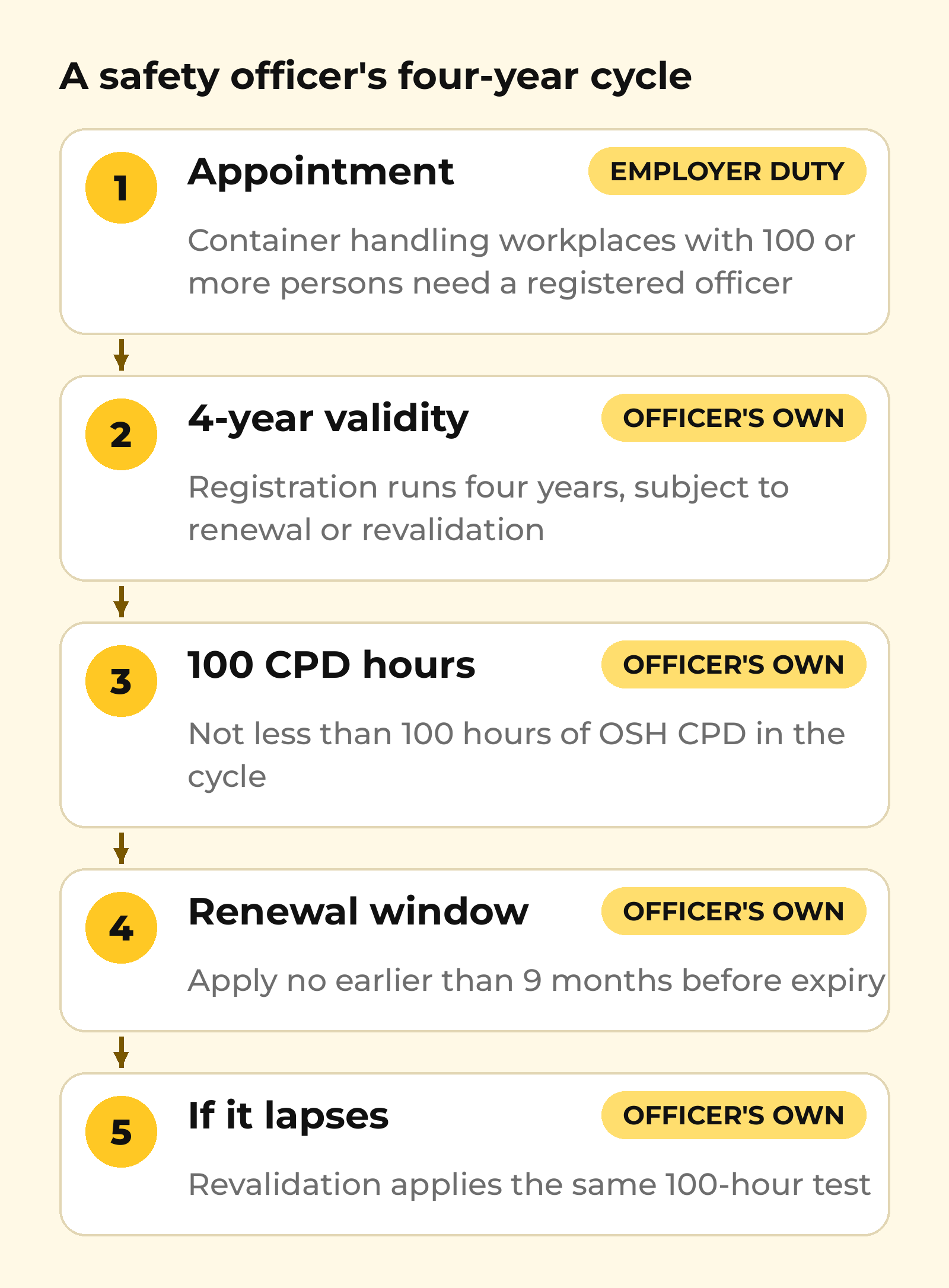
Two consequences follow from the way the rule is written, and both are easier to handle early than late.
The first is that the counting window moves with the application. Because the hours that count are those in the four years immediately preceding the application, an officer who applies nine months early also stops earning countable hours nine months early for that cycle — the courses attended in the final months before expiry cannot be added to an application already submitted. For an employer trying to help, the practical rule is to know which month the application will be made in, and to plan the training calendar backwards from that month rather than from the expiry date.
The second is that the cycle does not bank goodwill. Hours in excess of the requirement cannot be carried forward to the next cycle, and an activity can be claimed only once, in one category. So the failure pattern is not “the officer never trains”; it is “the officer trained hard in year one, did nothing for two years, and cannot recover the shortfall in year four because there are not enough countable courses left in the window”.
Which hours count, and which count less than you would think
The Guidance Notes accept five categories of activity: short or long courses (taught, distance or e-learning), professional conferences and seminars, professional publications and innovations, professional services on boards and committees, and the development of safety and health strategies or training programmes. In-house courses organised by employers are explicitly accepted as taught programmes, which is the part most employers never use.
What they rarely read is the ceiling on each category per cycle. Courses offered by the Government, government-related organisations, professional bodies or educational institutions are accepted up to a ceiling of 99 in a cycle, and courses offered by others up to 50. Conferences and seminars are accepted up to 99, publications and innovations up to 99, professional services up to 50, and developing a strategy or training programme up to 50 hours. Within the publications category, one hour may be claimed for every 500 words published, and up to 50 hours for each item of innovation; developing each strategy or training programme earns not more than 10 hours.
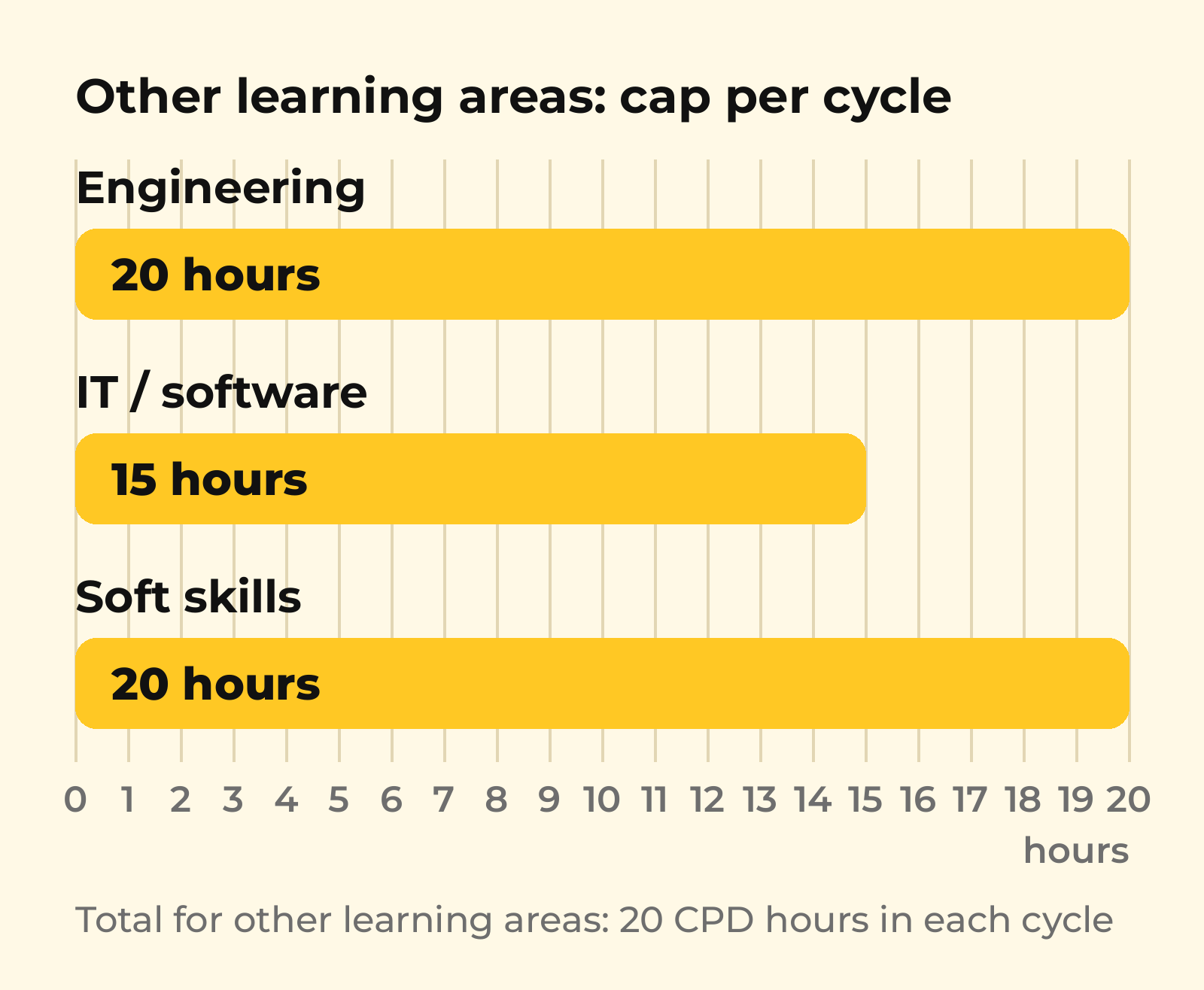
Then there is the limit that catches well-meaning employers. Training in other learning areas — engineering, IT and software application, and soft skills — is accepted, but capped at 20 hours in total in each cycle, against per-subject maxima of 20, 15 and 20. A generous internal development menu built around communication, leadership and software training therefore delivers far fewer countable hours than the hours delivered. The same arithmetic applies to the officer who designs your safety programme: developing it is worth not more than 10 hours each time, however much work went into it.
The design question for an employer is not “how many courses can we offer” but “which of these will be accepted, under which cap, with what evidence”. A certificate of attendance and a programme rundown are what the renewal file needs; a calendar invitation is not.
The person who runs your training is the person whose clock is running
The statutory duties of a safety officer are listed in regulation 15(1)(a) to (k). Among them: preparing and submitting a report to the proprietor on or before the last day of every month; receiving, discussing and countersigning every report submitted by a safety supervisor; investigating accidents and dangerous occurrences and reporting recommendations; and advising the proprietor on implementing a safety management system, including assisting in organising a safety and health training programme.
Look at that list from the employer’s chair and the dependency is uncomfortable. The person whose registration your appointment duty depends on is also the person your workers’ training depends on, and one of the few recurring records they generate — the monthly report — is a training and hazard record that most organisations file once and never use again. If their registration lapses, two things break at the same time: the appointment is no longer a registered one, and the training programme loses the person who was supposed to be organising it.

What an employer can hold without owning someone else’s duty
None of this transfers the officer’s obligation to the company. The Guidance Notes are explicit that the safety officer should keep a personal record of what they pursued in the preceding four years and set up a personal system for filing the supporting documents, and that the onus of furnishing the information and evidence rests with the applicant. What an employer can do is stop being surprised.
Four things are worth holding where someone other than the officer can see them: the registration number and its expiry date for every officer you rely on; the start and end of each officer’s current CPD cycle; the hours earned so far, split by the category they will be claimed under; and the certificates or attendance records that support those hours. Add one more that has nothing to do with CPD: which of your workplaces sit near a headcount threshold that triggers a duty to employ a registered officer, because a workplace that grows past it needs one in place before the headcount arrives, not after.
A learning platform is a reasonable place to hold the first four. Licence types and the cycle each one uses can be maintained in the system, so a four-year cycle is a record rather than a memory; a person’s licence registration — number, dates and validity — can be stored, with the hours they need set for them; reports can show hours earned and outstanding for a person against a licence, and a personal record can be exported as PDF, which is close to what the renewal file asks for. Where the hours come from outside the company, employees can submit externally attended training with the supporting certificates and the hours they wish to claim, the request goes to their line manager for approval with comments, and a rejected submission can be corrected and resubmitted — which gives the external half of the cycle the same trail as the internal half. None of that replaces the Commissioner’s rules or the officer’s own file; it means the organisation can see the running total instead of being told about it in month forty-seven.
Where the shortfall is not hours but content — site-specific hazards, a new plant, a method your crews have not used before — standard courses rarely fit, and that is where bespoke courseware earns its place rather than more seat time on generic safety modules.
The version of this that fails
It fails quietly, in a company that has never had a problem. The officer is experienced and respected, the site is safe, and the registration is simply a line on an organisation chart. Then the officer moves to another employer, or a growing headcount pulls another workplace past a threshold, or the renewal comes back because too many of the claimed hours turned out to be soft skills, and the company discovers that the appointment it has relied on for years was one expired registration away from being no appointment at all.
The check takes an afternoon. List every officer you depend on, write down the expiry date and the cycle, count the hours that will actually be accepted, and look at the gap between that and 100. Then look at which of your workplaces would trigger a duty to employ a registered officer if the headcount moved by ten. Wherever the arithmetic is thin, the fix is a training plan for this cycle, not for the next one.
Sources
- Labour Department: Guidance Notes on Continuing Professional Development Programmes under the Factories and Industrial Undertakings (Safety Officers and Safety Supervisors) Regulations (4th edition, in force from 1 January 2023)
- Labour Department: Registration of Safety Officer and Safety Auditor (frequently asked questions)
- Labour Department: How to apply for registration as a safety officer
- Labour Department: Factories and Industrial Undertakings (Safety Officers and Safety Supervisors) (Amendment) Regulation 2001
Cyberwisdom Asia Ltd. is a Hong Kong provider of learning management systems, CPD compliance software and bespoke courseware, serving 800+ enterprise clients since 1999.
About Cyberwisdom