On this page
Hong Kong has no single CPD rule. Accountants, securities licensees and insurance intermediaries each follow their own regulator or professional body, and the hours, reporting year, topic minimums and record-keeping periods all differ. This guide compares the three regimes side by side, then shows what an employer has to track when staff fall under more than one.
Requirements checked on 22 October 2026 against the sources listed at the end. Regulators revise their rules, so confirm the current text with your own regulator before relying on any figure here.
CPD, CPE and CPT: the same idea, different names
Continuing professional development (CPD) is the structured learning professionals complete to keep their knowledge and skills current, as their licence, registration or membership requires. Accounting bodies often use the same term. The Securities and Futures Commission (SFC) calls its version continuous professional training (CPT). For a broader introduction, see what CPD compliance means in Hong Kong.
The three regimes compared
| Requirement | HKICPA members | SFC licensed persons | Insurance intermediaries (IA) |
|---|---|---|---|
| Who it applies to | Members of the Hong Kong Institute of Certified Public Accountants, unless exempt | Licensed representatives, responsible officers, relevant individuals on the HKMA register, and executive officers | Licensed individual insurance agents and licensed technical representatives (agent) and (broker) |
| Hours | 120 per rolling 3-year period | 10 per calendar year; 12 for responsible officers and executive officers | 15 per Assessment Period |
| Minimums within the total | At least 60 verifiable hours and at least 20 hours in every year | At least 5 hours on topics relevant to the regulated activities; at least 2 hours on ethics or compliance | At least 3 hours on Ethics or Regulations |
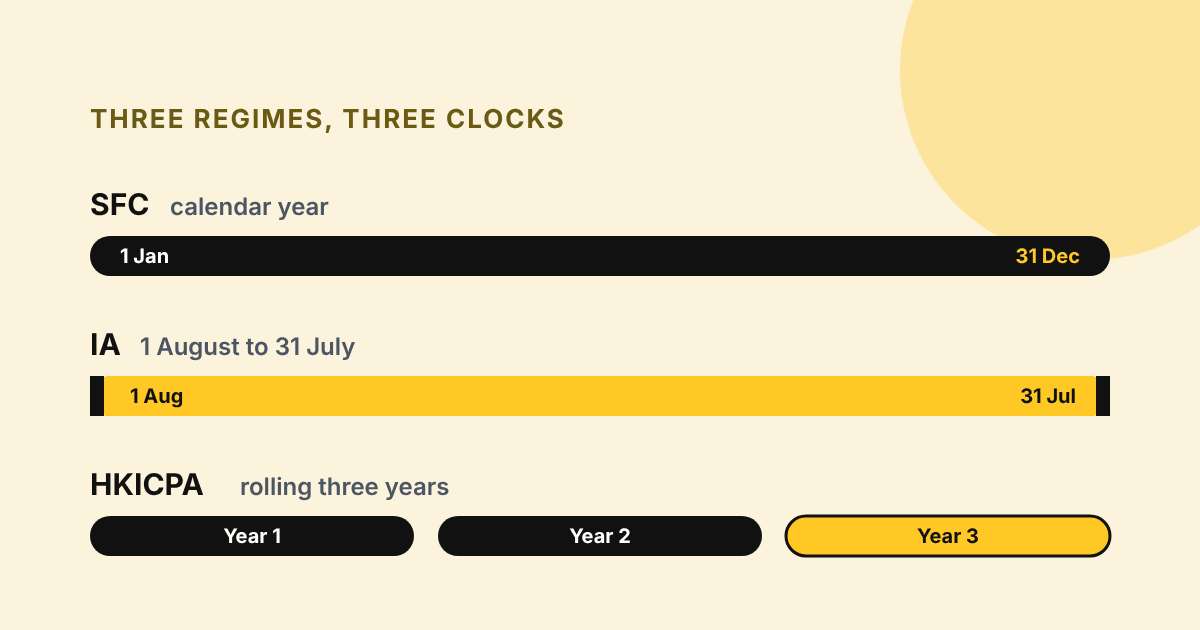
| Reporting period | Rolling three years; each reporting year begins on 1 December | Calendar year | 1 August to 31 July |
| Reporting | Records produced if the member is selected for an HKICPA audit | Corporations, responsible officers and licensed representatives confirm compliance to the SFC for the previous calendar year when filing annual returns | CPD Declaration reported to the IA and to the appointing principal by 30 September |
| Record keeping | Evidence of verifiable hours for at least 5 years | Evidence for at least 3 years | Evidence for at least 3 years after the end of the Assessment Period |
HKICPA members
Under the HKICPA’s CPD requirement (Statement 1.500), members complete 120 hours of relevant CPD in each rolling three-year period. At least 60 of those hours must be verifiable, meaning they can be confirmed by a competent source such as a course certificate or an organizer’s confirmation. Reading professional journals is an example of non-verifiable activity. At least 20 hours are needed in every year.
The HKICPA’s CPD FAQ also describes new ethics-related requirements: from 1 December 2025 for responsible persons of registered PIE auditors and practising certificate holders, and from 1 December 2026 for all members, at least 2 verifiable ethics-related hours each year within the 20-hour annual minimum. It also states that from 1 December 2026 at least 30 of the 60 verifiable hours must be structured learning. Members with specialist designations and responsible persons of registered PIE auditors have additional topic minimums. Check the current Statement 1.500 for your own status.
SFC licensed persons
The SFC’s Guidelines on Continuous Professional Training apply to licensed corporations and registered institutions, and to individuals licensed or registered to carry out regulated activities. A licensed representative or relevant individual must complete at least 10 CPT hours per calendar year. Responsible officers and executive officers must complete 12, which includes 2 additional hours on regulatory compliance.
Within those hours, at least 5 must be on topics directly relevant to the regulated activities the individual is licensed for, and at least 2 must be on ethics or compliance. A new individual must also complete 2 hours on ethics within 12 months of becoming licensed. Individuals first licensed part-way through a year have pro-rated hours, hours from a previous employer in the same calendar year can count, and excess hours cannot be carried forward to the following year.
Both corporations and individuals must keep documentary evidence of CPT, such as attendance certificates or exam results, for at least 3 years.
Insurance intermediaries
The Insurance Authority’s Guideline on Continuing Professional Development for Licensed Insurance Intermediaries (GL24) requires individual licensees to earn at least 15 CPD hours in each Assessment Period, which runs from 1 August to 31 July. At least 3 of those hours must be on Ethics or Regulations. Licensed technical representatives (agent) restricted to travel business have a lower requirement of 3 hours with no compulsory Ethics or Regulations hours.
Since 1 August 2025, a responsible officer of a licensed insurance broker company must also earn at least 2 hours on topics related to their management responsibilities, which count towards the 15.
Licensees must report their activities to the IA and to their appointing principal by 30 September, and keep evidence for at least 3 years after the end of the Assessment Period. Principals must request, check and verify the supporting evidence.
What this means for employers
The differences between regimes create real tracking work for any organization with more than one kind of regulated professional.
- The clocks do not line up. A calendar year, a 1 August to 31 July Assessment Period and a rolling three-year window can all apply in the same organization.
- Topic minimums are separate from the hour totals. An hour of general management training may count towards the total but not towards the ethics or regulated-activity minimum.
- Record-keeping periods differ. Evidence kept for 3 years satisfies the SFC and the IA but not the HKICPA’s 5 years. An organization serving several regimes should keep records for the longest period that applies.
- Employers have duties, not just individuals. The SFC expects firms to keep training records and confirm compliance in their annual returns, and the IA expects principals to verify evidence.
- Excess hours rarely carry over. Under the SFC and IA rules, hours above the requirement cannot be carried forward to the next period.
A practical checklist
- List every group of staff and map each to the regime that applies to them.
- Record each regime’s period, total hours and topic minimums as rules, not as notes in a spreadsheet.
- Tag every learning activity by topic, so that ethics, regulations and regulated-activity hours can be counted separately.
- Store the certificate or attendance record with the learner’s transcript, and keep it for the longest retention period that applies.
- Review progress before each deadline, not after it.
- Be able to produce a complete record for one person, or for the whole firm, on request.
Where a system helps
Spreadsheets and email folders are where this usually breaks down: different rules per regime make the formulas fragile, and the evidence lives somewhere else. An LMS with a CPD engine credits hours automatically as learning is completed, applies each regime’s rules, and produces audit-ready records. That is what UpLearn with the Cyberwisdom CPD Engine is designed to do. If you are comparing platforms, see how to choose an LMS. Cyberwisdom is a Hong Kong provider of learning management systems, CPD compliance software and bespoke courseware, serving 800+ enterprise clients since 1999.
Sources
- HKICPA: CPD requirements (FAQ)
- SFC: Guidelines on Continuous Professional Training
- Insurance Authority: Guideline on Continuing Professional Development for Licensed Insurance Intermediaries (GL24, August 2025)
- Insurance Authority: CPD for licensed insurance intermediaries
Cyberwisdom Asia Ltd. is a Hong Kong provider of learning management systems, CPD compliance software and bespoke courseware, serving 800+ enterprise clients since 1999.
About Cyberwisdom