On this page
What changed in 2024, and which of the two numbers bites
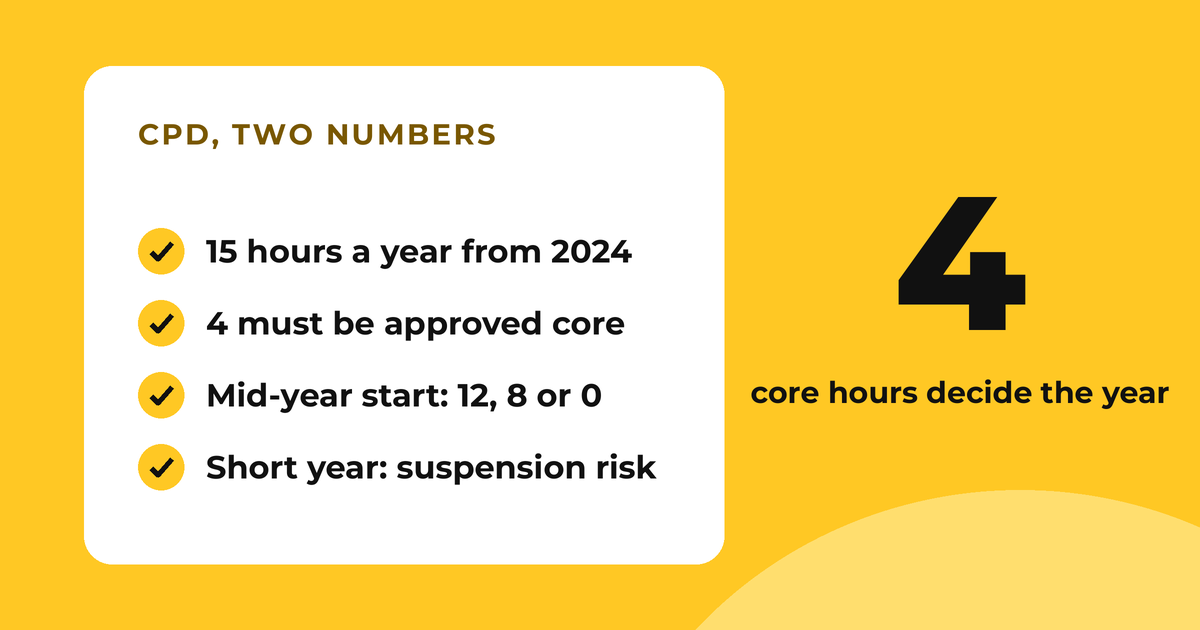
Before 1 January 2024 the requirement was 10 hours a year, two of them core. From that date the MPFA raised it to 15 hours and four core hours, under the revised Guidelines on Continuing Training for Subsidiary Intermediaries. The headline change is the five extra hours. The change that alters how a year has to be planned is the two extra core hours, for a reason that has nothing to do with the size of the numbers.
A general CPD hour can come from a wide range of activity: a seminar, a conference, an in-house session, a webinar, a relevant course. A core hour cannot. Only activities that have obtained prior approval from the MPFA are recognised as core, and the MPFA publishes the list of currently approved core activities on its website. The distinction is not a nicety about labelling; it decides which hours are even capable of counting towards the four.
That is why the two numbers behave differently. A firm can close a fifteen-hour gap late in the year by running an internal briefing or pointing people at recorded sessions, and those hours can count towards the non-core total. It cannot manufacture a core hour that way, because an internal session is not an approved core activity unless it has been approved in advance, and approval for a core topic is a step the activity provider takes with the MPFA, not a decision the firm or the intermediary makes on the day.
The four core hours come from a list you do not control
Read the guideline closely and the core hours are a supply problem before they are an attendance problem. The MPFA approves core activities in advance, publishes the approved list, and recognises as core only activities that have obtained that prior approval. For non-core topics, internal training organised by a service provider is acceptable; for core topics, an intermediary must attend an activity that is already on the approved list.
Three practical consequences follow.
First, the calendar matters more than the effort. An intermediary who leaves the core hours until December is competing for places on a fixed list of approved activities that other intermediaries are trying to complete at the same time. The hours are available in principle and scarce in practice, and the scarcity concentrates at exactly the point in the year when everyone notices the same gap.
Second, an activity being useful and an activity being core are different questions. A well-run internal session on communication skills or risk management may be the most valuable hour an intermediary spends all year, and it will count towards non-core hours, because those are non-core subjects for which internal training is accepted. It will not count towards the four unless it is on the approved list, and an intermediary who assumes otherwise finds out at the annual return rather than in October.
Third, there is a small allowance that rewards the people who teach. A registered intermediary who also trains on a qualified core or non-core activity can earn CPD hours for the time spent teaching, at one CPD hour for each teaching hour. That is a genuine route to core hours for the small number of intermediaries who deliver approved training, and it is invisible to the majority who only attend. Study time used to prepare for the MPF Intermediaries Examination does not count at all, which is worth saying because it is the one kind of study an intermediary might reasonably expect to be credited and is not.
An illustration makes the difference concrete. Two intermediaries each log fifteen hours. The first spends all fifteen on in-house briefings and a conference, none of it on the approved core list. The second splits the same fifteen between a smaller number of approved core activities and ordinary sessions. Both have met the fifteen-hour total; only the second has met the core requirement. The number that looks identical on a completion report is not the number that decides the year.
A mid-year start lowers the total, not the core
Not everyone is registered for the whole year, and the guideline handles that with a pro-rata table rather than a single annual figure. An intermediary newly registered on or after 1 April is measured on a reduced total for that first calendar year, but the core requirement does not fall in step with it.
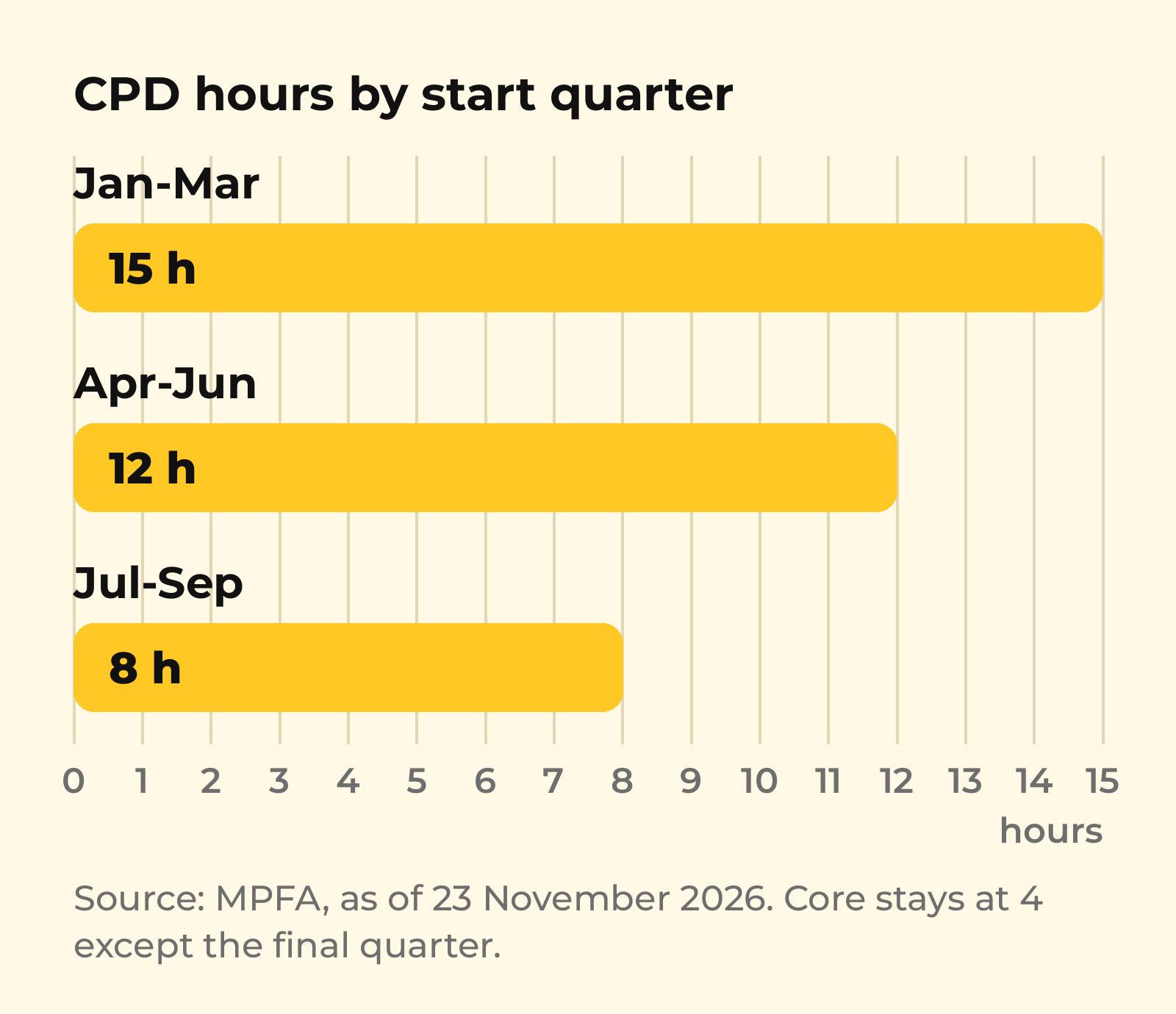
Read down the table and one column barely moves. The total drops from fifteen to twelve to eight, and then to zero for someone registered in the last quarter. The core requirement stays at four for the first three windows and falls to zero only in the last, which means a person who registers in July faces eight hours in total but still four of them core: half the total, not a quarter of it. The pro-rata concession is real, and it is smaller than the headline reduction suggests.
Two further rules make the first year easier and harder at once. Activities taken earlier in the same calendar year count even if they were taken before registration, so an intermediary registered in August can count what they did in January. But the requirement to comply runs for as long as the person remains registered, including any period when they are not attached to a principal intermediary and any period of suspension. Being between firms is not a gap in the CPD year.
What a short year actually costs
The consequence of falling short is often described loosely as a penalty. It is better understood as a sequence, because each step is different and the last one is the expensive one.
If an intermediary does not complete the required training, the MPFA may suspend the registration. That step is discretionary: the guideline says the authority may suspend. If the shortfall is still not made up within 30 days after the start of the suspension, the MPFA may revoke the registration. A person whose registration was revoked for not meeting the CPD requirement must resit and pass the MPF Intermediaries Examination before being registered again.
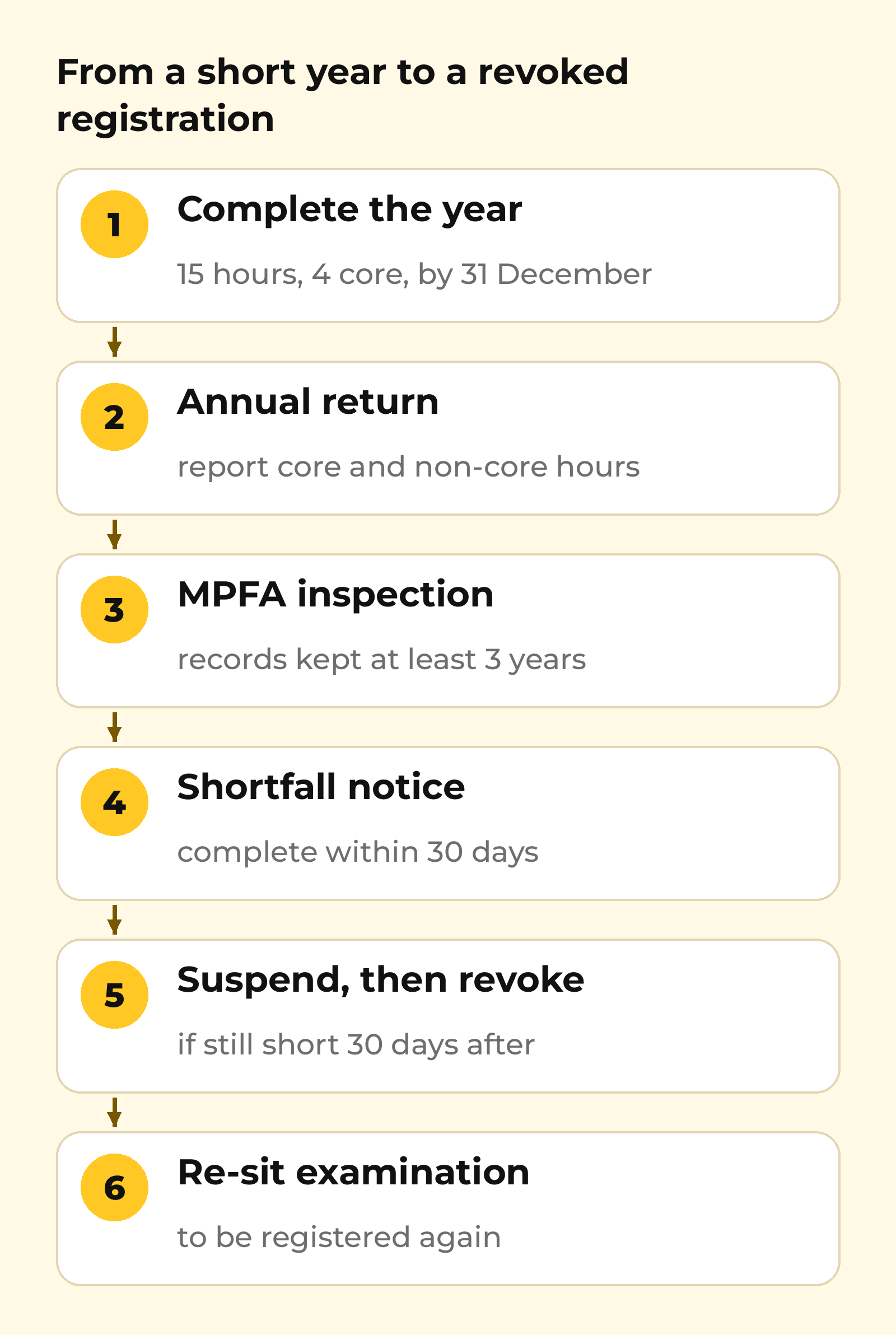
The arithmetic of that sequence is worth sitting with. A single missed year does not produce a fine; it produces a suspension that can become a revocation if it is not cured within 30 days, and a revocation sends the person back to an examination that has nothing to do with the hours they skipped. For an intermediary whose income depends on being registered, the real cost of a short year is not the hours; it is the period of suspension and the examination at the end of it.
The duty is personal; the evidence can be shared
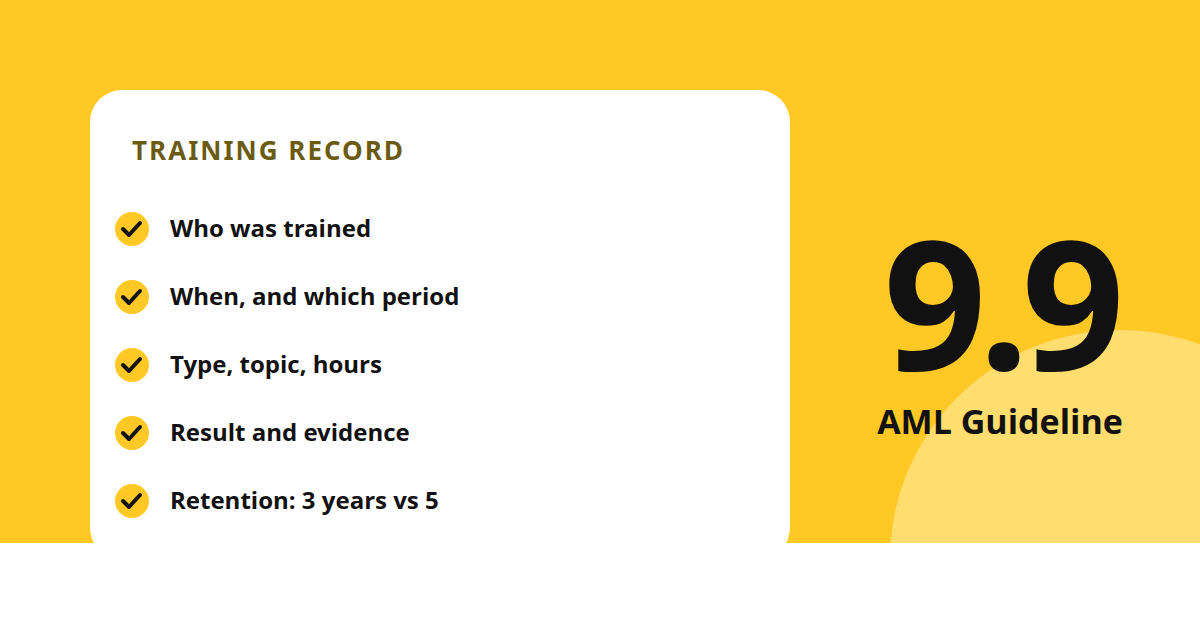
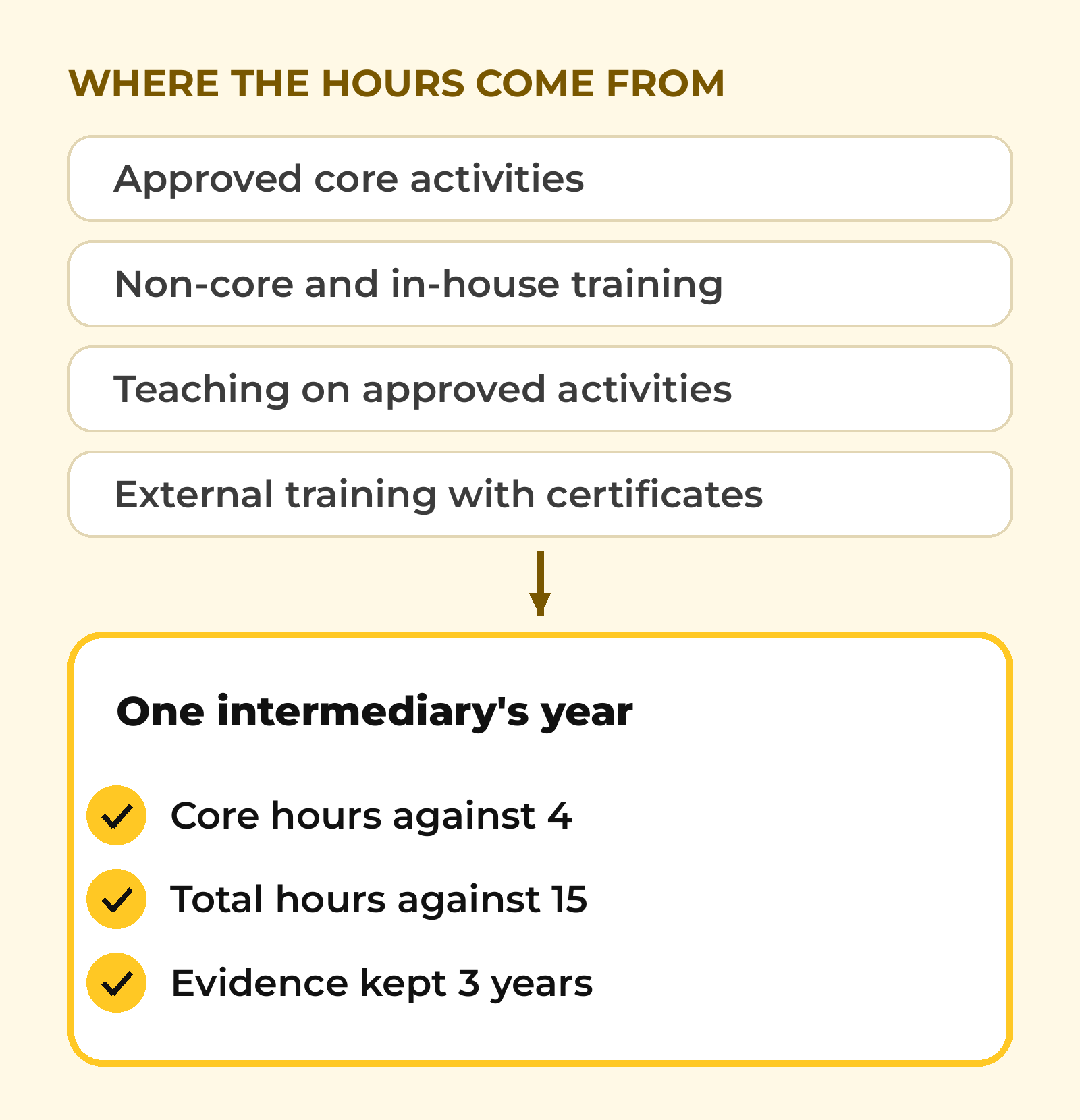
The obligation and the evidence sit in different places, and the gap between them is where firms get surprised. The CPD requirement is on the individual subsidiary intermediary. The annual return is the intermediary’s, reporting the core and non-core hours undertaken in the preceding calendar year, and the records have to be kept for at least three years because the MPFA may inspect the documentary evidence. The intermediary does not have to send every attendance record with the return, but must be able to produce the records if asked.
The evidence, meanwhile, is generated in several places. An approved core activity produces a record with the provider. A non-core session produces an attendance record with whoever ran it. Teaching on an approved activity produces a record with the organiser. External training produces a certificate the intermediary holds. At the end of the year these have to add up, for one person, into the two numbers the annual return asks for.
That is the point at which a records system earns its place, and it is worth being precise about what it does and does not do. UpLearn can hold each learner’s licence registration, including the number, the dates and the validity, and the required hours can be adjusted where an individual’s position changes (capability P-02), which suits the pro-rata start described above. Where a course carries credited hours, completing it can credit those CPD/CPT hours automatically (capability P-03), although that does not change whether an activity is approved as core; approval stays with the MPFA. CPD reports show hours earned and outstanding for a person against a licence, and a personal record can be exported as a PDF (capability P-07), which is the format an intermediary can keep against an inspection. Where hours are earned outside the firm, employees can submit externally attended training with supporting certificates and the CPD/CPT hours they wish to claim, and the request goes to a line manager for approval, with comments (capability LM-05).
None of that approves a core activity, makes the annual return, or turns a short year into a complete one. Those stay where the guideline puts them: with the MPFA and the individual. What the firm can do is make the two numbers visible before December, so that a shortfall in either is discovered while there is still time to act on it.
Before the next annual return, keep three columns for each subsidiary intermediary and update them through the year rather than at the end of it: total hours against the requirement for that person’s registration window, core hours against four, and the evidence held for each. The first tells you whether the year is on track; the second tells you whether it is on track in the only category that cannot be improvised; the third is what turns a completed year into a defensible one.
Two limits belong here. This describes the position for individual subsidiary intermediaries as published by the MPFA as of 23 November 2026, and it is not legal advice; it does not cover the separate obligations of principal intermediaries, nor the treatment of a particular case, which is a question for the MPFA. And a number that is right today is not permanent: the requirement has already moved once, from ten hours to fifteen, and the first thing to check in any future year is whether it has moved again.
Sources
- Mandatory Provident Fund Schemes Authority: Continuing Training, frequently asked questions for subsidiary intermediaries, including the 15-hour and 4-hour core requirement, the pro-rata table and the consequences of non-compliance
- MPFA: Ongoing Requirements for MPF intermediaries, including the increase from 10 to 15 hours and from 2 to 4 core hours with effect from 1 January 2024
- MPFA: Guidelines on Continuing Training for Subsidiary Intermediaries (Guidelines VI.4, Version 2, August 2023), effective 1 January 2024
Cyberwisdom Asia Ltd. is a Hong Kong provider of learning management systems, CPD compliance software and bespoke courseware, serving 800+ enterprise clients since 1999.
About Cyberwisdom